जब बच्चा रात को चाँद माँगे: The Ramayana Toddler Tantrum Hack & Pediatric Neuroscience
A calm bedroom environment, elevated rest, and simple hydration help soothe nighttime autumn coughs.
“Doctor, my two-year-old had a complete meltdown last night because we wouldn't let him play with the TV remote. He screamed, threw toys across the room, and cried for twenty straight minutes. No amount of explaining, pleading, or scolding helped. What do we do when a toddler refuses to listen to reason?”
Almost every young parent who visits Charak Clinics in Mohali and Chandigarh shares this exhaustion. You feel frustrated, helpless, and worried whether you are doing something wrong.
Here is the first clinical truth to remember: You are not failing as a parent, and your two-year-old is not being naughty. Their brain is simply undergoing one of the most intense developmental leaps in human biology.
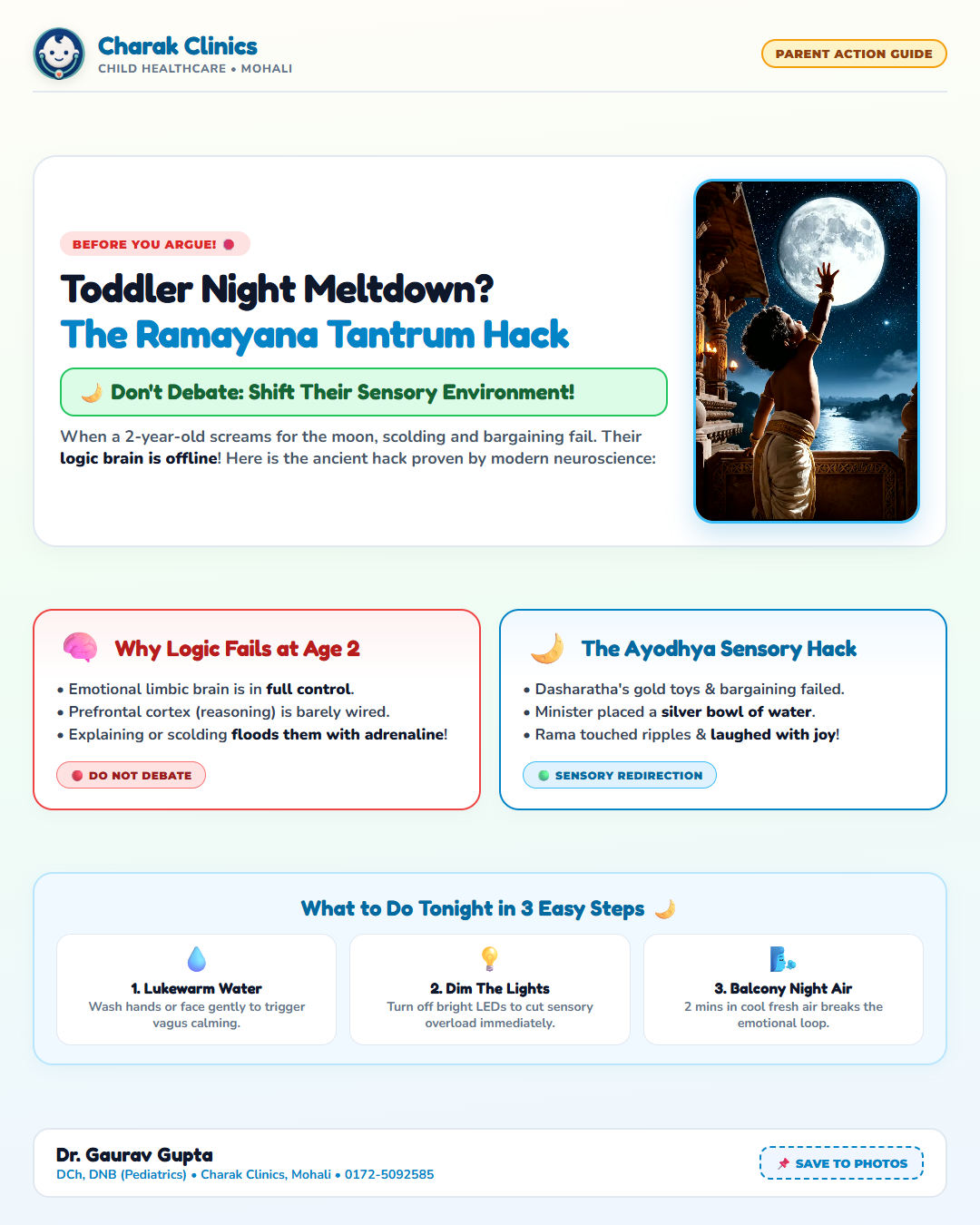
Interestingly, the most effective clinical hack for handling a toddler meltdown was documented thousands of years ago in the ancient Ramayana.
The Ancient Story: When Toddler Rama Demanded the Moon
According to the Valmiki Ramayana, two-year-old Rama was playing in the palace courtyards of Ayodhya when he looked up at the full moon. Enchanted by its glow, he demanded: “Mujhe woh chaand chahiye!” (I want that moon to play with!).
King Dasharatha and Queen Kausalya tried everything a modern parent tries:
- Bargaining & Distraction with Toys: They brought glittering golden toys, fruits, and sweets. Rama pushed them away and cried louder.
- Logical Explanation: They tried telling him the moon was millions of miles away in the sky. To a two-year-old, logic meant nothing.
Seeing the royal family helpless, a wise royal minister did not argue. He simply fetched a heavy silver dish filled with still water and placed it on the terrace floor beneath the night sky. The moon immediately reflected in the water with crystal clarity.
Toddler Rama crawled forward, touched the cool ripples with his tiny hands, saw the moon “caught” in the dish, and burst into delighted laughter. The tantrum ended in seconds.
The Neuroscience: Why Arguing with a 2-Year-Old Fails
As pediatricians, we see this ancient wisdom perfectly mirrored in modern developmental neuroscience:
- Prefrontal Cortex is Under Construction: The rational, logic-processing part of the brain (the prefrontal cortex) does not fully mature until age 25. At age 2, it is barely wired.
- The Emotional Limbic Brain Dominates: During a tantrum, the toddler's amygdala (the brain's emotional alarm system) takes full control. The child is literally in a physiological state of overwhelm.
- Sensory Redirection Over Verbal Debate: When a child is in an emotional flood, words like “understand why you can't have this” sound like white noise. The only pathway out is through the sensory nervous system. The minister changed Rama's environment and gave him a tactile, visual sensory reset.
The 3 Pediatric Sensory Resets to Try Tonight
The next time your toddler locks into an uncontrollable meltdown, do not debate, scold, or lecture. Instead, execute one of these 3 sensory resets:
1. 💧 The Water Reset
Gently wash their hands with lukewarm water or dab a cool wet washcloth on their wrists and face. The mammalian dive reflex calms heart rate and resets the autonomic nervous system.
2. 💡 The Visual Reset
Dim harsh overhead white lights immediately. Bright LED lights over-stimulate an already agitated nervous system. Soft, warm lighting signals security.
3. 🌬️ The Atmosphere Reset
Step out onto the balcony or open the window for fresh cool night air. The abrupt change in temperature and tactile airflow instantly breaks the sensory loop.
Watch the Full 60-Second Video
Watch Dr. Gaurav Gupta explain this exact technique with cinematic Ramayana visual recreation on your favorite platform:
- ▶️ YouTube Shorts: जब बच्चा रात को चाँद माँगे... 🌙 Ramayana Parenting Hack!
- 📸 Instagram Reel: इतिहास का पहला और सबसे असरदार पैरेंटिंग हैक! 🌙✨
When to Consult Your Pediatrician: The Red Flags
Occasional 5-to-15 minute tantrums are completely normal milestones between ages 18 months and 3 years. However, consult your child specialist if you notice:
- Tantrums accompanied by head-banging or self-injury.
- Breath-holding spells resulting in fainting or turning blue.
- Tantrums lasting consistently longer than 30-45 minutes multiple times daily.
- Severe speech delay or lack of eye contact alongside frequent meltdowns.
Need Pediatric Guidance in Mohali or Chandigarh?
Dr. Gaurav Gupta provides evidence-based developmental and pediatric consultations at Charak Clinics, SCF 30, Phase 3B2, Mohali.
Medical Disclaimer: This content is for general educational purposes only and does not substitute for professional medical advice, diagnosis, or treatment. Always consult your doctor for personal medical guidance, vaccines, or medications.